Pedal position tells you what the driver asked for. Throttle position tells you what the engine controller allowed. Those are related signals, but they are not the same thing.
When the pedal rises and the throttle does not follow, it is tempting to call the gap a bad throttle body or a weak tune. Neither conclusion is safe from one channel. Modern GM controllers use throttle, spark, fuel, boost, transmission state, and torque limits together. The log has to establish which part of that system acted, and why.
Start With the Right Channels
Log these signals together before making a torque-management conclusion:
- Accelerator pedal position — the driver's request.
- Throttle position — the delivered throttle opening.
- RPM, vehicle speed, and transmission gear — the operating event and whether a shift is involved.
- Spark advance and knock retard — shows whether spark changed beside the throttle event.
- MAP and barometric pressure — establishes engine load and, on boosted combinations, pressure ratio.
- Actual and commanded fuel pressure plus lambda — rules out a fuel-delivery event that happened at the same time.
- Any available torque source, torque limit, or intervention status channels — their names differ by controller, but they supply useful context when present.
The full HP Tuners logging checklist explains why a channel list should match the question. Do not add every PID just because it exists. A slow sample rate can hide a short throttle event.
What Normal Looks Like
On a clean, steady acceleration event, pedal and throttle usually rise together. They do not need to match as exact percentages. Their scaling, filtering, and reporting ranges can differ by controller.
The useful question is whether the relationship changes in the same part of the drive every time:
- Does throttle trail pedal only during a shift?
- Does it happen at the same RPM and load?
- Does spark fall at the same instant?
- Does the fuel system or knock response change first?
- Does it repeat in the same gear and under comparable conditions?
A one-sample mismatch is not a diagnosis. A repeatable gap, with the surrounding channels recorded, is evidence worth following.
Separate a Controller Intervention From an Engine Problem
Throttle closure can be the controller doing exactly what it was designed to do. Before changing driver-demand or torque-related tables, rule out the condition the controller may be protecting.
A shift or traction event
If the gap occurs only at a gear change, wheel-slip event, or traction-control intervention, it may be part of normal torque coordination. Compare a steady pull in the same gear before treating it as a calibration problem.
Knock, temperature, or fuel pressure
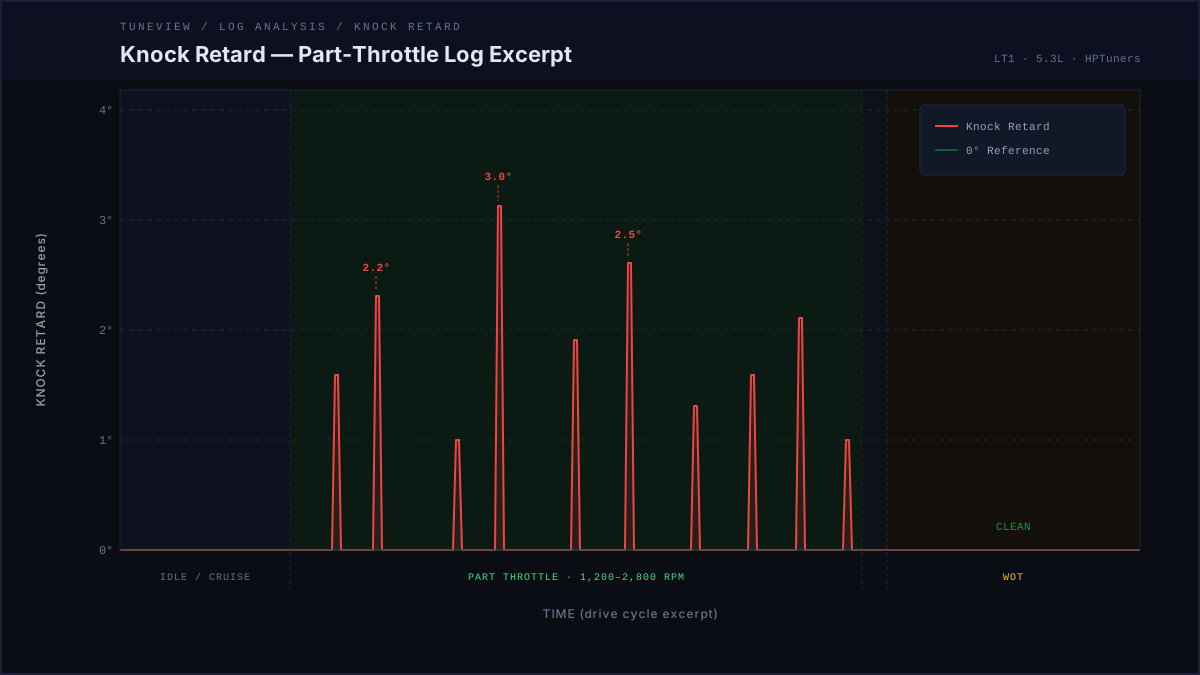
If knock retard rises, intake temperature climbs, or actual fuel pressure misses its target before throttle falls, the throttle gap may be a response rather than the root cause. Fix the measured condition first. The spark-table guide covers why delivered spark has to be read beside load, temperature, fueling, and knock.
A repeatable torque limit
If pedal repeatedly exceeds throttle in the same loaded region, with no shift, traction event, knock response, or supply problem explaining it, then a torque-control path is a credible next investigation. That is still a prompt to inspect the correct controller strategy for the exact vehicle and build, not permission to remove safeguards wholesale.
Use a Comparable Test
Treat the baseline and follow-up as an experiment:
- Start with the same scanner configuration and sample rate.
- Use the same gear and a comparable RPM range where practical.
- Record ambient conditions, fuel, and major build changes.
- Change one evidence-supported calibration area.
- Re-log, then compare pedal-to-throttle behavior with spark, pressure, lambda, and knock beside it.
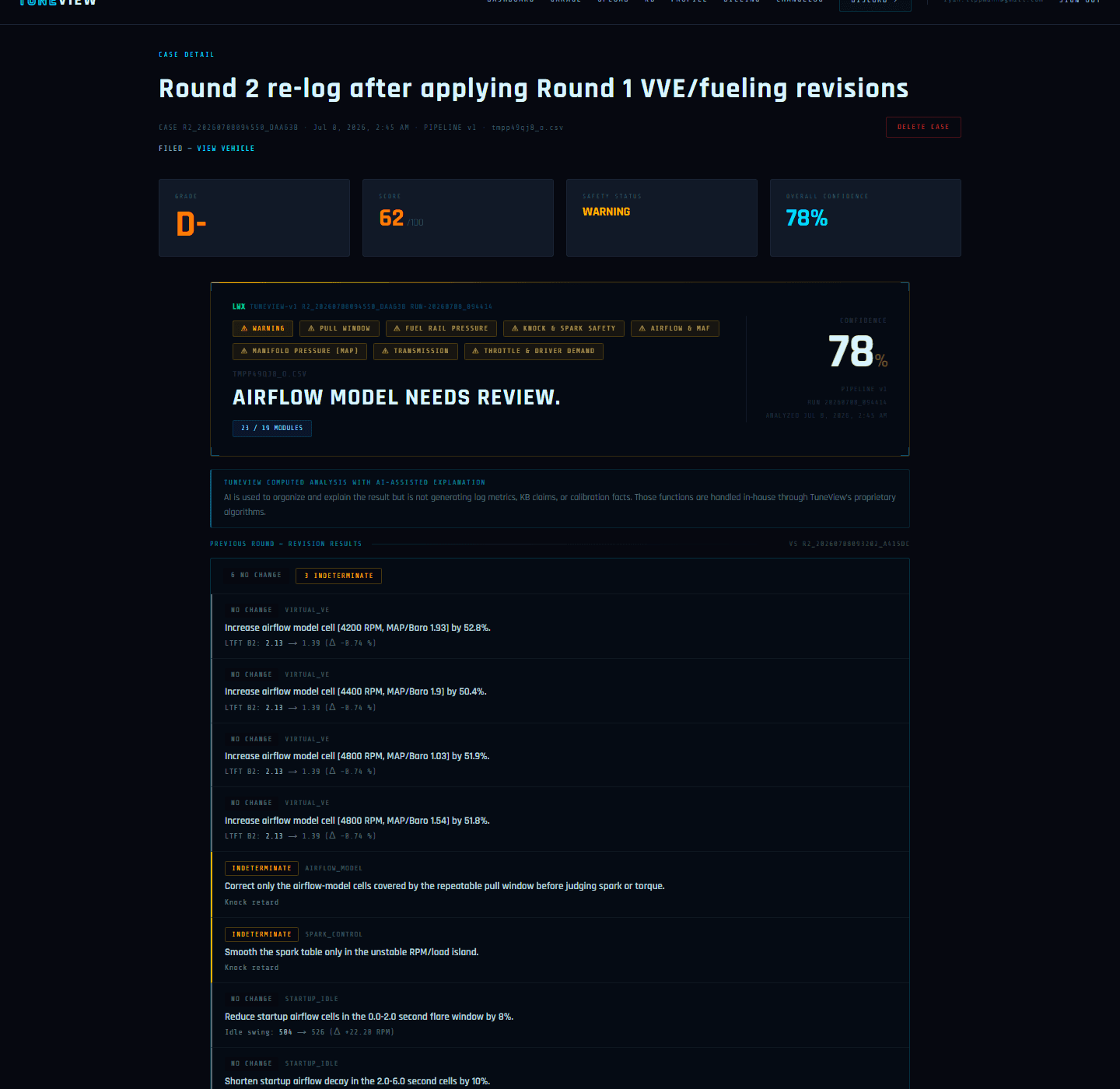
The founder's 416 Whipple Sierra revision loop illustrates why this order matters. Its second round found a repeatable throttle-to-pedal gap, but the same round also carried airflow and spark findings. One signal does not erase the other.
What the Follow-Up Must Prove
A revision is not successful because throttle position looks closer to pedal position. The comparable log must also show that the engine stayed healthy:
- no new knock pattern,
- lambda remained near the commanded behavior for the tested region,
- fuel pressure stayed under control,
- the event is repeatable rather than a one-off condition,
- and the driver response improved where the baseline showed the gap.
If any of those pieces moved the wrong way, the change needs another explanation. More throttle is not automatically more usable torque, and a log is more valuable when it can tell you that plainly.
See the Pattern in Your Own Log
TuneView reads HP Tuners logs as evidence first. A Full Tune gives one GM vehicle unlimited analysis and revision rounds, so the baseline finding and the follow-up verdict stay attached to the same vehicle history.
Full Tune is $69 one-time for one vehicle/motor, with unlimited analyses and revision rounds and no expiration.
TuneView helps HP Tuners users turn scanner logs into guided calibration revisions. Support for GM platforms is live.