// 01 · THE UPDATE
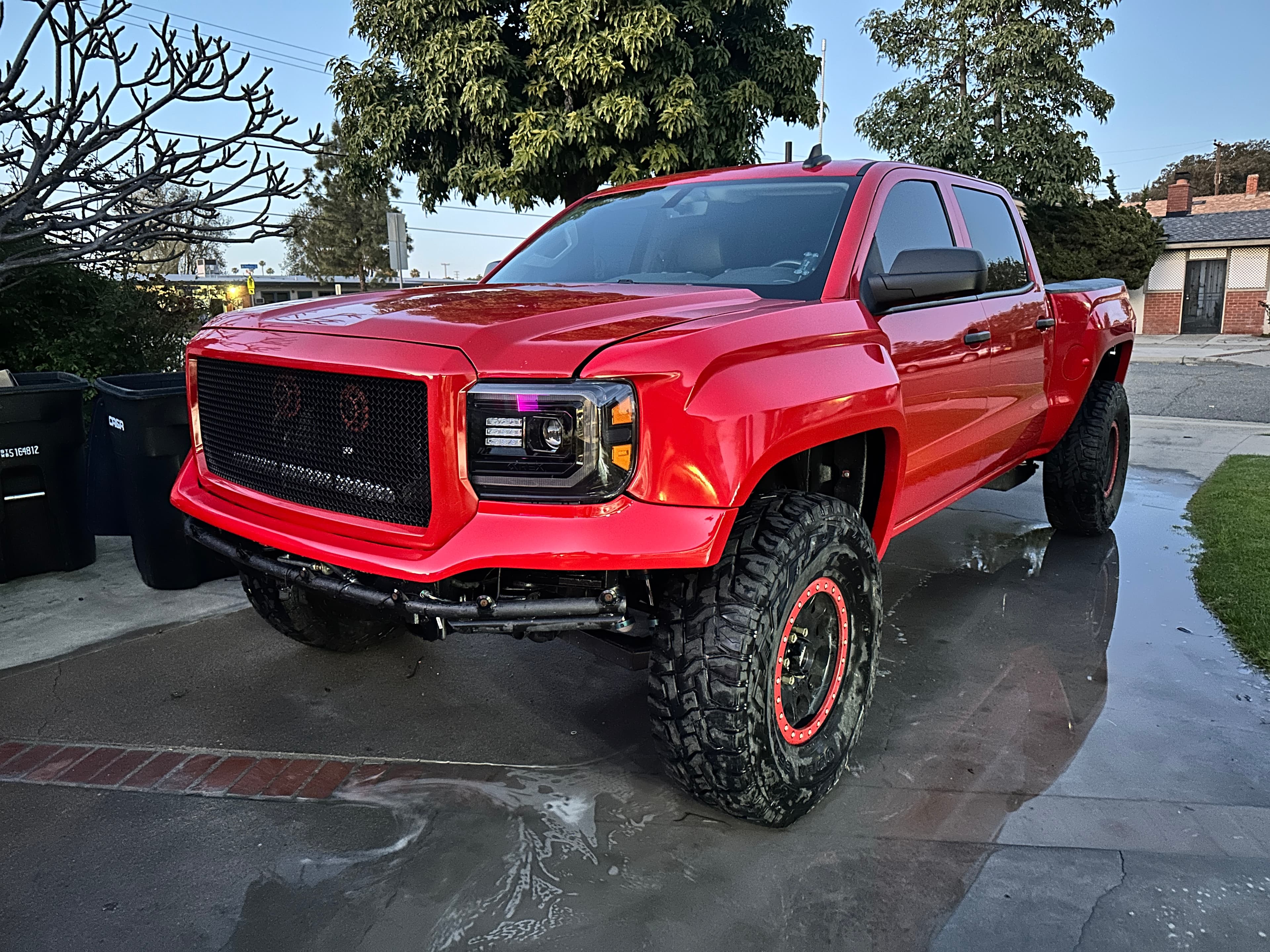
Welp, here we go again. Sierra is coming off the tuning path for a while. Not because the revision loop stopped mattering, but because the truck needs structural work before it earns another pull. This is the dark side of owning a project car, truck, etc.
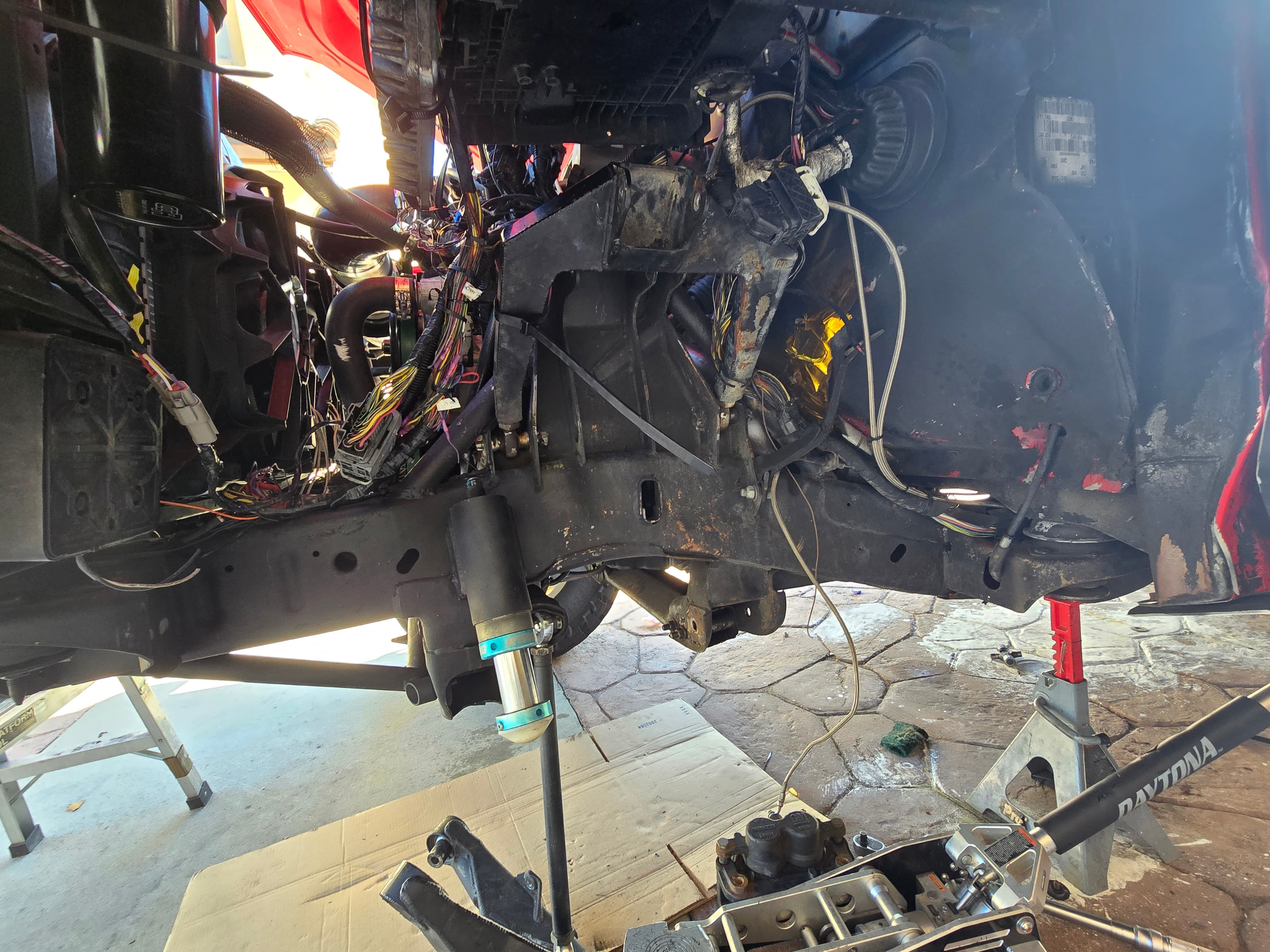
How did I find it? It started with replacing all of the uniballs on the long travel kit (COM-24T = 2, COM-16T = 8, COM-10T = 20) which has evolved into an every other or every 3rd year maintenance routine. I noticed that the steering was feeling a little loose and I had some really accelerated tire wear on the inside of the front tires which had never been there before. I knew what was going on but didn't want to accept reality and what it meant for the truck and my wallet, so I ignored it until I couldn't. Eventually the driver's side tire was playing some sweet tunes on uniball at the top of the spindle upright where the camber angle due to the rolled frame had increased more than the UCA gave room for it to do so. That was the last straw. I decided to do the homework today and start to plan this facelift out so I have something to look forward to. So I tore down the driver's side today, surveyed the frame rail at 15 stations, three inches apart. What I found was that across a 21-inch window, the rail rolled inboard at the top; the peak reading was 12.1° from baseline.
That is not a number to tune around. It's not a number that a frame shop can pull out effectively either. It's now a front end surgery.
// 02 · WHAT THE SURVEY FOUND
I'm not a frame shop. I don't have the frame repair procedures from GM however I know a thing or two about a thing or two and figured out that GM doesn't want these things repaired. You can buy a front frame section but it's so tiny - it doesn't even get into any real load window - it's all outside of that on the very front end. I'm looking at cutting this thing at the firewall and going from there. Here's how I got there: the reference was not a factory frame-table dimension. It was the healthy part of the same rail, measured with the same magnet-mounted digital protractor at two elevations on the web face. The front was supported on one driver-side jack stand, so the absolute angle to gravity is not the point; the change from the healthy ends is.
| Area surveyed | Measured result | What it means |
|---|---|---|
| Stations 1–3, 0–6 inches forward of the datum | 84.2–85.5° | Baseline section |
| Stations 4–10, 9–27 inches forward | 81.7° down to 74.2° average | Twist zone |
| Station 9, 24 inches forward | 72.7° lower / 75.8° upper | Peak: 12.1° inboard roll at the top of the rail |
| Stations 8–10 | Up to 5.1° between upper and lower readings | The web itself is locally warped, not simply rotated |
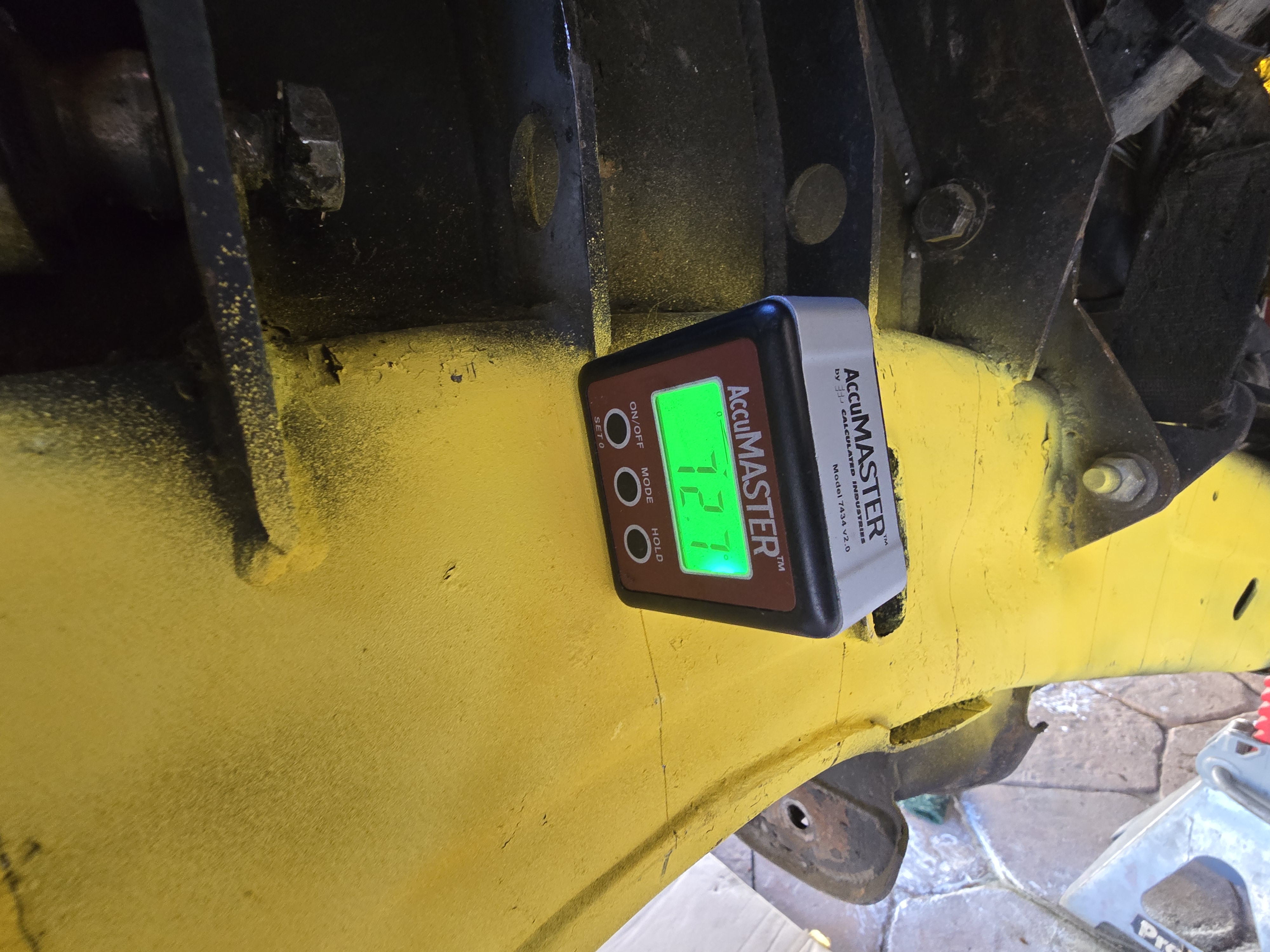
The point is not to make the report sound worse than it is. It is to describe it accurately: the driver-side rail is not one clean, uniform bend that can be waved away. The middle is twisted, and the web has local deformation too. The ends provide a control; the middle is the evidence.
I documented the survey with 29 timestamped photos and a station-by-station data sheet. That is enough to set the direction. It is not a substitute for the cross-measurements, passenger-side control survey, and frame-table verification the repair needs before the work starts.
// 03 · WHAT CHANGES NOW
The plan is no longer to keep assembling the front end and find out later how the truck behaves. The engine comes out. The damaged driver-side front frame horn will be replaced with a complete donor section after the repair shop confirms the cut location, fixture strategy, and final geometry. It's almost a 100% certainty that the passenger side is almost as bad and honestly it makes things easier to replace both rails at the same time as one unit assembled together. Things line up better that way. A new front-suspension kit and an engine cage belong in the same phase.
That is a bigger project, but it is the right fix for the problem unfortunately. It puts the truck back on a verified foundation instead of asking steering, suspension, alignment, and power to work around questionable steel.
There are still gates before it becomes a finished repair:
- Verify the rail rearward of the surveyed datum and measure the passenger side as a control.
- Verify status of the passenger side rail.
- Rule out sweep and diamond with cross-measurements before any structural work.
- Have the frame shop select and validate the donor section, repair process, and acceptance measurements.
- Confirm chassis geometry, suspension, and alignment after the structural work is complete.
No one gets to call this done because a part was ordered or a seam was welded. The same measured comparison that found the problem will be part of the verification after the truck is back together.
// 04 · NO LOGS FOR A WHILE
The obvious consequence: there will not be new founder-vehicle logs for a bit.
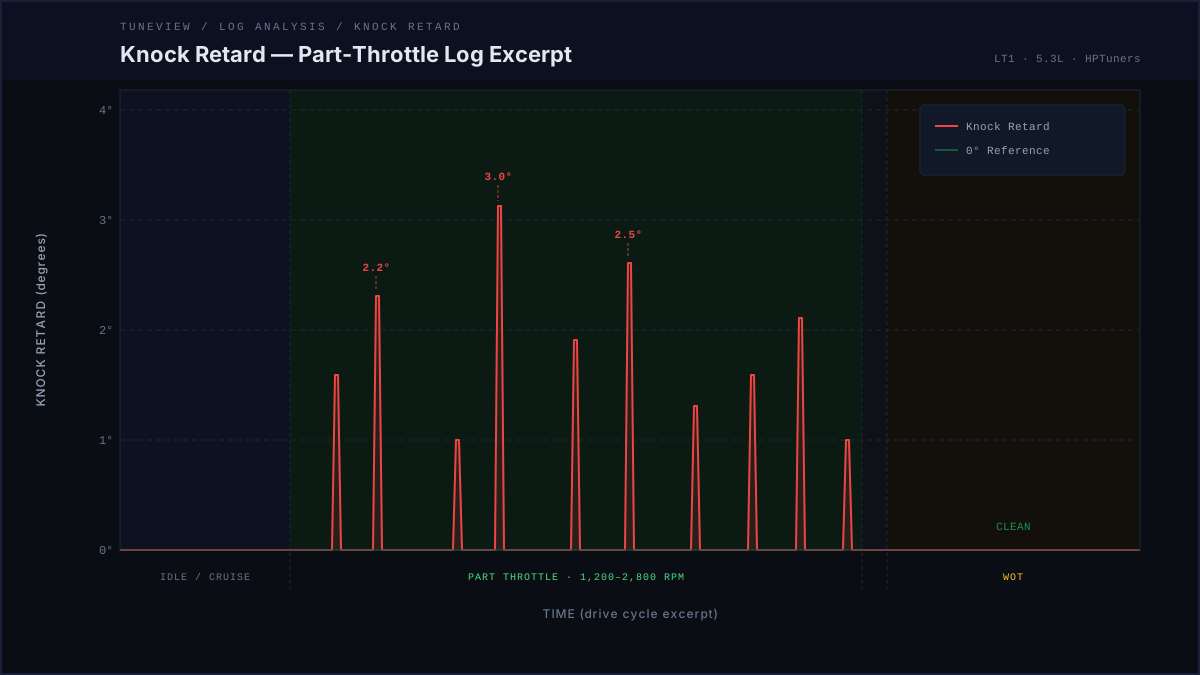
I am not going to turn that gap into a pretend tuning update. The truck is paused because a safe, straight foundation comes before another revision round. When it returns, the first log will be treated as a new baseline after real structural and suspension work—not as proof of an outcome before the work exists.
The Sierra is still the same development vehicle behind the 416 Whipple case study. It has always been the place where I can test the whole loop honestly: make a change, record it, measure it, and keep the result even when it is inconvenient. That discipline applies here too.
// 05 · THE WORK WHILE THE TRUCK IS DOWN
The building phase gives me a forced stretch away from the next pull. I have a lot of TuneView and LambdaWorx work waiting for that time, and it will get a focused run while the Sierra is apart.
The next founder-vehicle update will be concrete: what the shop verified, what was replaced, what was installed, and what the post-repair measurements show. The update after that can be about logs again.
For now, the order is simple: make the truck structurally right, verify it, reassemble it, then go back to the loop. Trucks are fun. Trucks are fun. Trucks are fun. Trucks are fun. Trucks are fun.